


A blue whale arrives in Varna with a message to the global maritime community
Copied & translated from: https://www.maritime.bg/151465/
On September 8, 2026, a life-size inflatable model of a female blue whale, approximately 28 meters long, will be unveiled at the entrance to the Sea Garden in Varna. The whale is named Star and will focus public and professional attention on a serious, but still insufficiently recognized problem – unintentional collisions between ships and whales.
The initiative is organized by the global Whale Guardians program, with the valuable support of the organizers of the International Maritime Forum Global Compass and the Municipality of Varna. The event takes place on the day when Varna welcomes shipping companies, representatives of maritime administrations and regulatory bodies, shipowners, charterers and operators, captains, officers, educators and specialists involved in daily maritime operations.
Varna is a particularly suitable location for the initiative. The city is an established maritime center with shipping and management companies, maritime institutions, educational institutions and long-standing traditions in the training of maritime personnel. The Higher Naval School "N. Y. Vaptsarov", Technical University - Varna and Varna Maritime High School "St. N. Chudotvorets" and their developed centers for professional training play an important role in the knowledge and practices of future and current maritime specialists.
Why whales are vital
Whales are marine mammals that play a key role in the health and productivity of the ocean. Through the so-called “whale pump,” they transport and recycle nutrients that support the growth of phytoplankton, the base of the marine food chain. Phytoplankton are involved in carbon sequestration and the exchange of oxygen between the ocean and the atmosphere. Healthy whale populations, biodiversity, climate balance, and sustainable coexistence between humans and the marine world are all part of an interconnected system.
A danger that often remains invisible
Unintentional collisions between whales and vessels of all types and sizes occur every day in the world's seas and oceans. They can cause serious or fatal injuries to the whales and often go unreported, so documented cases only reflect a fraction of the true scale of the problem.
Following industrial whaling, many whale populations have yet to recover to their former numbers. Ongoing collisions with ships are hindering the recovery of some and creating additional risks to their long-term survival.
The aim of the initiative is to make the risk more recognizable, for information to reach people and organizations that plan and execute maritime operations in a timely manner, and for available practical measures to be applied more widely.
From information to practical action
The most effective principle approach is to separate ships and whales in space and/or time. However, this is not always possible on a global scale, especially around ports, narrow sea lanes, and areas where important whale habitats overlap with established shipping routes.
Therefore, collision prevention requires a combination of measures adapted to the specific area, season, whale presence, navigational environment and traffic characteristics. These may include advance planning of the passage; use of up-to-date data and warnings in planning and execution; maintaining appropriate bridge surveillance; voluntary seasonal or local route adjustments; avoidance of known high-risk areas; speed management; reporting of sightings and incidents; and training of masters, officers and crews.
Where safe and operationally possible, crossing the continental shelf along the shortest practical route – approximately at right angles to its contour – can reduce the time spent in areas with a higher probability of whale presence. Approaches to ports and entry into sensitive sea areas during daylight hours can further assist in surveillance. However, visual surveillance is not a substitute for up-to-date data, good advance planning and the application of relevant routing and operational recommendations.
The role of Whale Guardians and the SCOUT initiative
Whale Guardians connects shipowners, charterers and operators, captains and crews, scientists, researchers, citizen science networks, conservation organizations, ports, local authorities, technology partners and regulatory institutions.
The program brings together whale presence data, vessel traffic information, and existing route and operational measures to prevent collisions at sea. It identifies risk areas and works with local experts and stakeholders to develop and disseminate science-based voluntary recommendations that are aligned with navigational safety and real-world maritime operations.
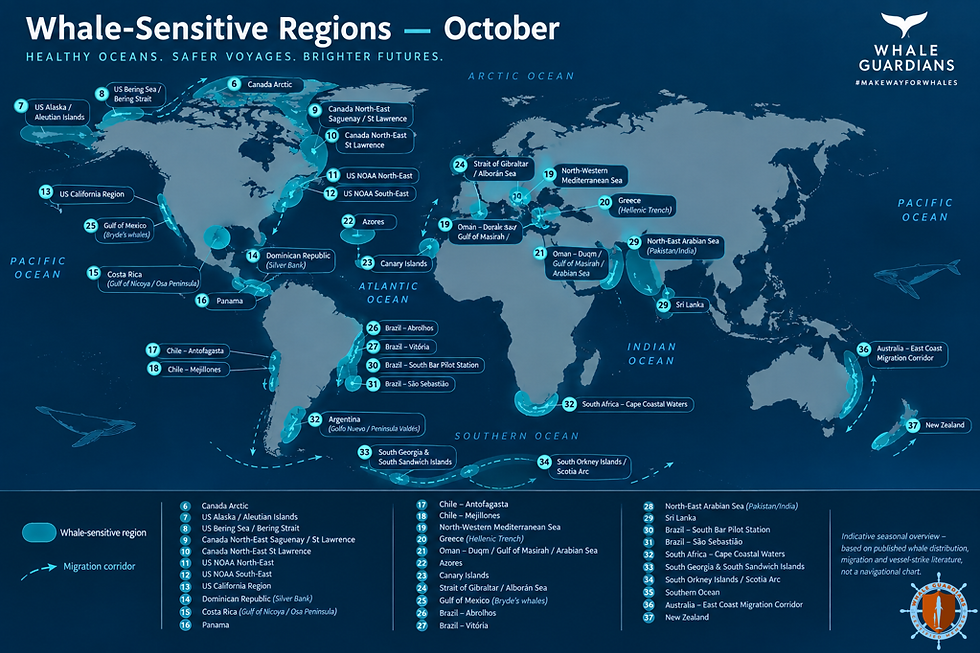
The Whale Guardians digital platform now functions as a consolidated platform for ship-whale collision prevention. It brings together known and approved recommendations from international organizations, port authorities, scientific and conservation bodies and program partners. The platform currently covers 27 sensitive marine regions and over 130 specific recommendations, indicating their source, period of application and whether they are mandatory or voluntary.
An important part of this work is the SCOUT initiative – a system for collecting observations of the presence and positions of marine mammals from ships sailing along established coastal routes and, over time, across all international trade routes. The aim is to fill gaps in the available data and to create more reliable, seasonally and geographically specific information about the areas where whales and ship traffic occur.
Through its participants and partners, Whale Guardians helps inform, train and provide practical guidance to thousands of sailors and ship crews, enabling them to contribute directly to collision prevention and the protection of oceans and whales.
“Mariners know and respect the ocean and its inhabitants and do not want their ships to cause harm to whales. Our goal in Varna is to make this often invisible risk more recognizable, to present the practical solutions available, and to connect the maritime community with scientists, ports, institutions, conservation organizations, and all those already working to protect whales. When knowledge and data become part of planning and daily operations, many unintended collisions can be prevented ,” says Capt. Svetoslav Todorov, Global Shipping Delegate for the Whale Guardians program.

Comments