


ON LOCATION: Whale Guardians in South Africa NOW

Members of the Whale Guardians team, including local manager Greg Vogt of Durban, South Africa, and Michael and Galen Fishbach and Heather Watrous from the US, are presently in the Western Cape of South Africa, meeting with environmental ministers, local whale tour operators and biologists, all of whom have valuable roles to play and contributions to make in Whale Guardians' coordinated effort to protect whales in South African waters. It is presently the high season for Southern Right Whales and Humpback Whales in the Cape Region.
Due to the increasing geopolitical pressures in the Middle East, shipping traffic has increased by 50% in the area rounding the Cape of Africa, placing thousands of whales in further danger of ship strike. Despite recent increases in population levels of Southern Right whales since the International Moratorium on Whaling in 1986, new threats have arisen. Periods between Southern Right whale calving have nearly doubled to 6 years (indicitave of reduced nutrition, and thus longer periods needed to build up the necessary blubber to sustain healthy pregnancy), and recently in Argentina, hundreds of calves have died due to bacterial infection.
Port regions of particular concern for ship strikes in South Africa are Richards Bay, Durban, East London, Cape Town, Saldanha, Port Elizabeth, Mossel Bay. Migratory routes in between these ports, especially June through November, with April through December being the fringe season, are also particularly concerning.
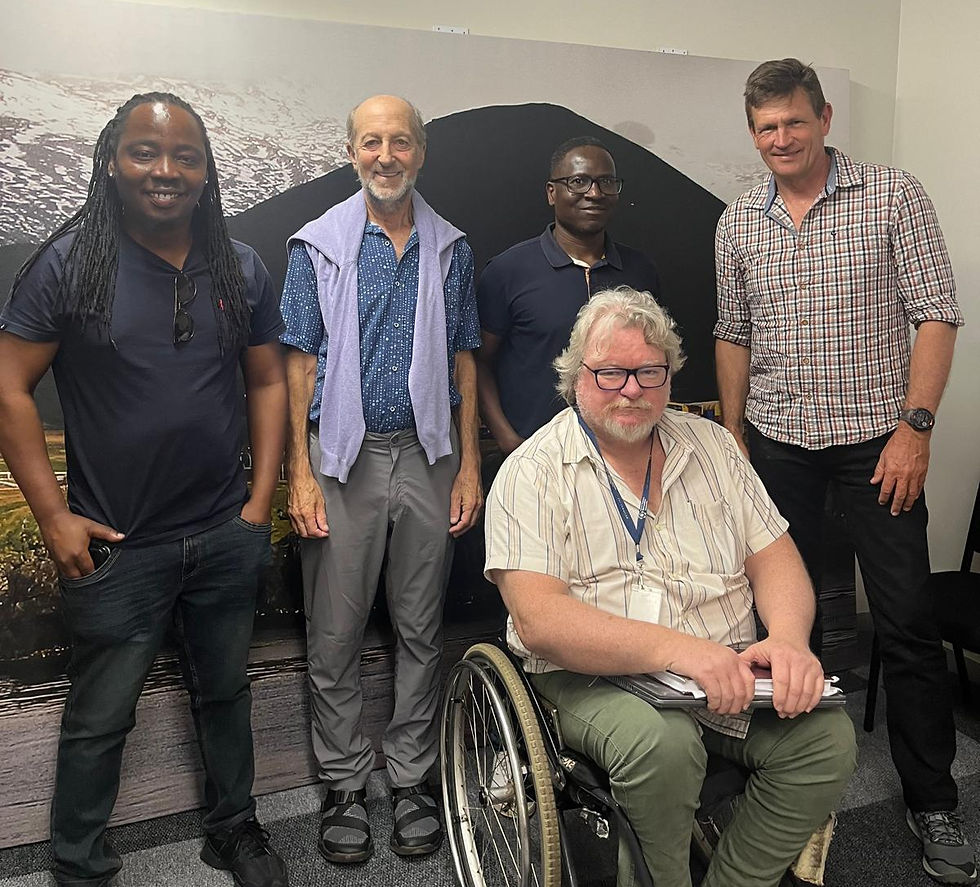
Professor Azwianewi Makhado, Specialist Scientist of Marine Top Predators and Seabirds, Gerhard Cilliers, Director Biodiversity and Coastal Research, and Mdudeuzi Siakamela, Specialist Researcher focusing on Marine Mammal Science, all representing the interests of the Environmental Ministry of South Africa, received the Whale Guardians team for an in depth introduction to our whale routing API for WG industry affiliate partner-members, a description of how Whale Guardians partners with shipping companies directly to ensure recommendations that work with industry working demands, and a demonstration of the SCOUT data collection device and program. They were particularly interested in how the SCOUT can be used not only by mariners operating large vessels, but will be of use for helicopter pilots who specialize in ship pilot transfer at port, Shark Board operators, fishermen, citizen science groups, biologists and marine tour guides.
Dave Hurwitz, owner and operator of the whale watch tour company, Simon's Town Boat Company, in Simon's Town, the gateway to Cape Point National Park, hosted the team for an outing and shared great conversation. He is a close observer of the changes at sea with increased shipping, increasing numbers of whales, and was excited to share the data he has collected over the years and collaborate with WG. Dave has also been following and documenting the two famous orca brothers with the drooping pectoral fins, whom he named Port and Starboard, that are responsible for dramatically decreasing the local shark population in the False and Walker Bay region since 2015.
Wilfred and Susan Chivel, founders of Marine Dynamics and the Dyer Island Conservation Trust, has brought hope to the world of sharks, whales, African Penguins, and other marine species via educational tours, scientific research, and conservation efforts, as well as a warm community hub and excellent jobs, to the local town of Gansbaai since 2006. Wilfred and Susan are presently hosting the team in Gansbaai, South Africa, for the second time. Marine Dynamics founded and built the African Penguin and Seabird Sanctuary in 2015, rescuing and caring for diseased, displaced, oiled or abandoned birds, while being open to the public for observation. At Marine Dynamics Academy, volunteer, undergraduate and postgraduate programs educate students in academic and field based skills within marine science and biology. Thousands of tourists come each year to The Big White House in Gansbaai, to have a Fair Trade meal under the giant Southern Right whale skeleton in the dining room, or to join Wilfred and his expert team to experience the thrill of close shark encounters, whales breaching, fur seal colonies, penguins, dolphins, albatrosses, and other wonders of the local environment.

Local South African tour owners have helped to build and grow the awareness and concern for whales and the oceanic ecosystem in the region, and all feel that the public must become more educated to help create lasting changes in approach of oceanic use to safeguard whale lives. Partnering with Whale Guardians is one way to help support them to advance their efforts. They have been working with biologists for decades, and collect and provide sound, proven data to support conservation, thus fitting right into the Whale Guardians program.
The team has visited both Betty's Bay, now an African Penguin sanctuary, and Saldanha Bay, home to former whaling stations. These visits have been sobering as we witnessed the decrepit remains of our former industrial exploitation of whales, from which they have yet to fully recover. It gave pause for poignant thought, in regards to the dire impacts of our human industrial endeavors, both past and present, and has deepened our resolve and commitment to protect these ocean giants and marine bioneers: the Great Whales.
Stay tuned for the next installment of ON LOCATION in South Africa, including profiles on these local heroes of whale conservation.
Captions for the photos:
1. Cow calf Southern Right pair resting together
2. Three Southern Right adults in a sensual late season mating dance
3. Adult Southern Right whale surfacing, showing blow holes and rostrum with callosities
4. Young African Penguin. Current populations reduced to 1% of their former population.
5. Adults and young African Penguins walking the beach at Betty's Bay, former whaling station


Comments